
AI document and search systems
Put your documents to work. Keep people in control.
We build AI document and search systems for teams that need to find information in their own material. Start with a defined collection and a clear question the system should answer.

When this helps
Useful information is spread across files and systems. A general-purpose chatbot does not know which sources your team can trust or who should see them.
This service is for document-heavy businesses, professional teams, and product builders evaluating search over a controlled collection.
What we deliver
- A source inventory and access rules
- A scoped retrieval-augmented generation (RAG) design
- A pilot with agreed questions and a record of answer checks
- Hosting, model-provider, and human-review decisions documented before rollout
How the work runs
- Choose one document collection and the users allowed to access it.
- Agree on useful questions, unacceptable answers, and review criteria.
- Build retrieval and answer flows, then test them against the agreed sample.
- Review limitations and costs before extending the system.
View the process infographic
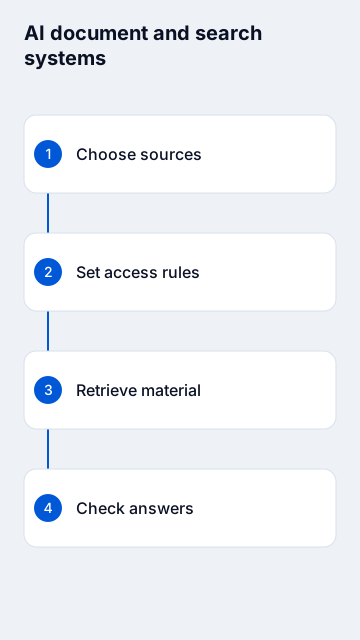
Diagram description
AI document and search systems
1. Choose sources
2. Set access rules
3. Retrieve material
4. Check answers
Conceptual service process, not measured results.
Document search: reference pattern
1. Approved sources
2. Ingest and index
3. Access-filtered retrieval
4. Model answer draft
5. Human source review
Conceptual pattern, not a client deployment.
Apply document permissions before retrieval, keep model-provider access separate, log without exposing document text, and review citations. This is a pattern for scoping, not a product feature claim.

Open diagram Download editable diagram
Diagram description
Document search: reference pattern
1. Approved sources
2. Ingest and index
3. Access-filtered retrieval
4. Model answer draft
5. Human source review
Conceptual pattern, not a client deployment.
Apply document permissions before retrieval, keep model-provider access separate, log without exposing document text, and review citations. This is a pattern for scoping, not a product feature claim.
What changes for your team
A tested basis for deciding where AI helps and where people must keep reviewing the source. Accuracy depends on the source material, retrieval design, and model behavior.
Scope and limits
AI can produce incorrect answers. A pilot does not establish fitness for legal, medical, financial, or other high-stakes decisions. Data location and provider terms must be agreed before sensitive files are used.
Related product work

Lwati is the group’s legal AI research platform for Southern African law. Ask about its current coverage and access.
Explore LwatiQuestions before you start
What is RAG?
Retrieval-augmented generation finds relevant material from a chosen collection before a model writes an answer. It can improve source relevance, but it does not remove mistakes.
Can the system run in our own environment?
We can assess self-hosted and cloud options. The choice depends on model requirements, hardware, licensing, and the data involved.
Will our documents train a public model?
We agree on providers and data-handling terms before use. Do not assume a provider’s training or retention policy without reviewing its current terms.
Related services


Start a conversation
Define your first document search project
Describe the document types, intended users, and questions they need answered. Share access and hosting requirements, not confidential files.